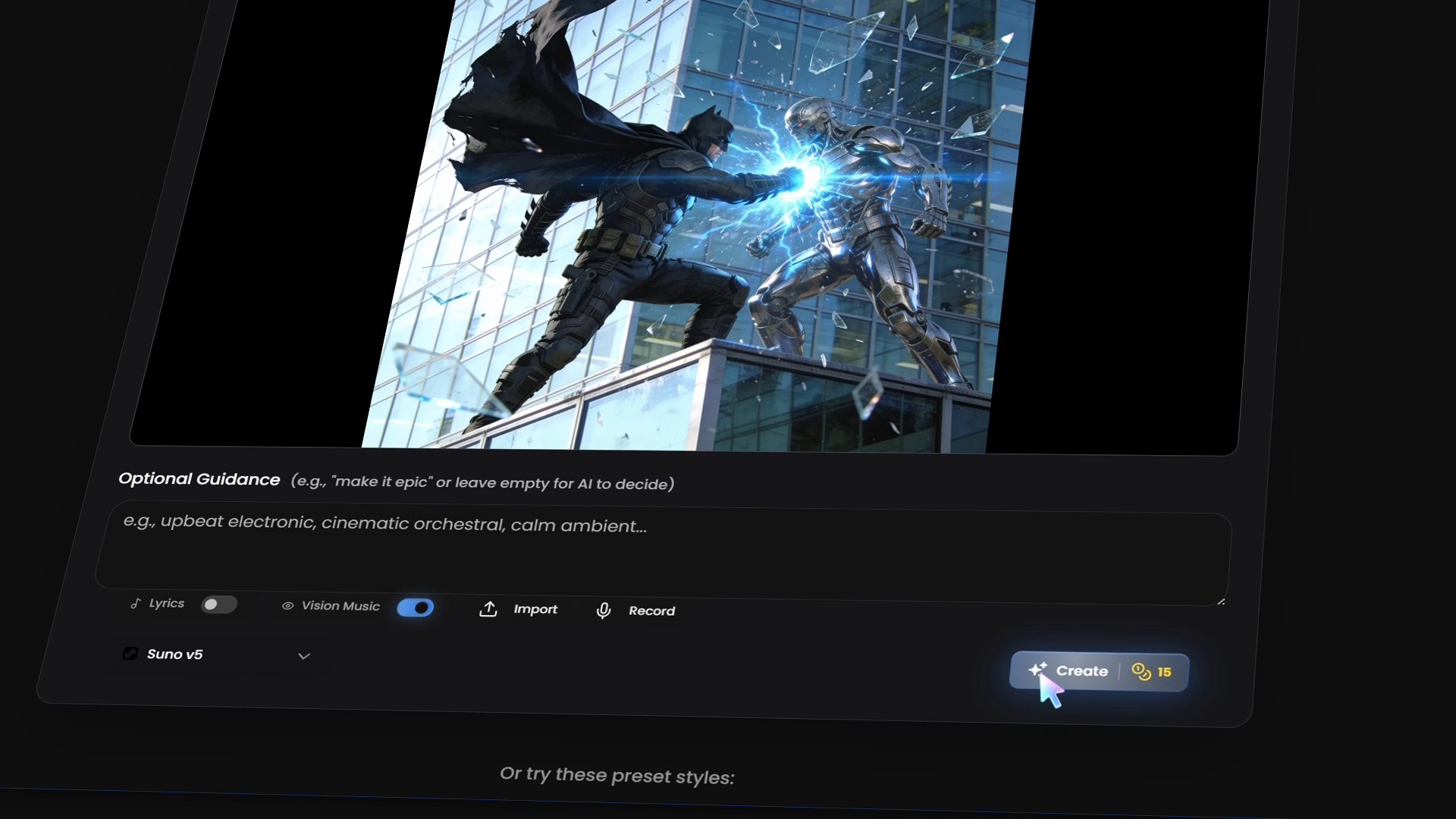
Most AI music tools need you to describe the music you want in a prompt. Vision Music skips that step. You give it an image or a video clip, it reads the visual, and generates an original soundtrack that matches the mood, tempo, and atmosphere of what it sees.
No prompt writing. No genre tags. No style references to upload. Just: visual in, music out.
How it works
- Upload an image or a short video (up to 30 seconds)
- Pick a music engine: Suno, Google Lyria, or Minimax (or let Kolbo auto-pick based on the visual)
- Generate the soundtrack. Typically 15 to 30 seconds depending on the engine.
That is the full workflow. There is no step four.
What Vision Music actually reads
The AI looks at three things when it scans a visual:
- Mood signals: lighting, color temperature, contrast, facial expressions, body language in video
- Energy signals: motion intensity in video, composition tension in stills, subject density
- Genre cues: setting, era, clothing, props, environment
A neon-lit night street produces a different track than a sunlit field, even if you never tell it that. A frantic action clip generates higher BPM than a slow pan across a portrait. That mapping is the whole product.
Pick your engine, or let Kolbo pick
Each of the three engines has a personality:
| Engine | Strength | Best for |
|---|---|---|
| Suno | Lyrical and structured tracks with vocals | Songs, jingles, marketing spots |
| Google Lyria | Cinematic instrumental, real instruments | Film scores, dramatic moments |
| Minimax | Tight loops and electronic | Ads, TikTok, social cuts |
If you do not pick, Vision Music chooses based on what the visual suggests. A movie still defaults to Lyria, a portrait with strong attitude defaults to Suno, a tight product shot defaults to Minimax.
Who this is for
Filmmakers scoring B-roll or pulling together a temp track for a rough cut. No more stock library scrub-throughs.
Marketers and ad teams producing on-brand audio for spots in seconds, with no licensing complications.
Content creators making Reels, Shorts, and TikToks where the track is everything. Match the music to the actual frame, not a hashtag genre.
Designers turning visual portfolios into multi-sensory pieces. Upload the image, generate the score, embed both.
A note on cost
Vision Music runs at 20 to 40 credits per track depending on the engine and duration. The free tier (100 credits) covers a handful of generations to try it.